
Tremie Pipe | Tremie Method of Underwater Concrete | Critical Features of Tremie Pipe Concreting

Underwater concreting is one of the most challenging operations in civil engineering and construction projects. When foundations, piles, bridge piers, or marine structures must be constructed below water level, conventional concrete placement techniques cannot be used due to cement washout, segregation, and contamination by water. To solve these issues, engineers rely on the Tremie Method of Underwater Concrete Placement, a highly effective technique that ensures continuous, high-quality concrete placement beneath water.
The tremie pipe system is specifically designed to deliver concrete directly to the desired location without allowing it to mix with surrounding water. This method is widely used in deep foundations, offshore structures, dams, cofferdams, caissons, and bridge substructures.
In this comprehensive guide, we examine the tremie pipe, the tremie method of underwater concrete placement, working procedures, components, advantages, and critical construction features essential for successful tremie concreting.
What is a Tremie Pipe in Civil Engineering?
A Tremie Pipe is a vertical pipe used to place concrete underwater while preventing direct contact between fresh concrete and water. The pipe is usually made of steel or rigid metal sections that are connected together with watertight couplings.
The tremie pipe extends from the concrete supply point above water to the bottom of the placement location, ensuring concrete flows smoothly and continuously from the bottom upward.
Key Characteristics of Tremie Pipe
- Constructed using strong steel pipes
- Typically 200 mm to 300 mm diameter
- Connected with flanged joints or screw couplings
- Includes a hopper at the top for concrete pouring
- Equipped with a plug or valve system at the bottom
The main objective of the tremie pipe is to maintain continuous concrete flow while preventing water infiltration, which ensures uniform, dense, and high-strength underwater concrete.
Understanding the Tremie Method of Underwater Concrete Placement
The Tremie Method is a specialized technique used to pour concrete underwater without segregation or cement washout. This method relies on gravity and controlled discharge to place concrete from the bottom upward, ensuring proper compaction and cohesion.
The tremie method is widely used in the construction of:
- Bridge foundations
- Pile foundations
- Marine structures
- Harbor works
- Dam foundations
- Cofferdams
- Underwater repair works
By keeping the lower end of the pipe submerged within freshly placed concrete, the method prevents direct contact between water and fresh concrete, maintaining its strength and durability.
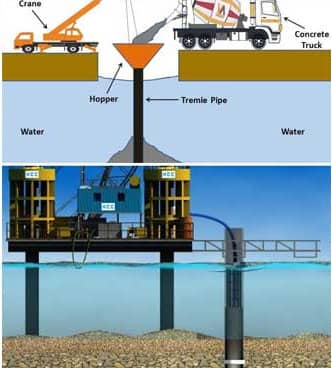
Main Components of a Tremie Concreting System
A complete tremie concrete placement system includes several essential components designed to maintain a continuous flow of concrete.
1. Tremie Pipe
The tremie pipe is the core component of the system. It consists of steel pipe sections that can be assembled depending on the required depth. These pipes must be watertight and strong enough to withstand hydrostatic pressure.
2. Hopper
The hopper is fixed at the top of the tremie pipe and acts as a funnel for pouring concrete into the pipe. It ensures a steady and controlled flow of concrete.
3. Plug or Bottom Seal
At the beginning of the operation, a plug made of foam, rubber, or plastic is placed inside the tremie pipe. This prevents water from entering the pipe when the first batch of concrete is poured.
4. Lifting Equipment
Cranes or lifting systems are used to lower and adjust the tremie pipe during the concreting operation.
5. Concrete Supply System
A continuous concrete supply from mixers or pumps is necessary to ensure uninterrupted placement.
Step - by - Step Procedure of Tremie Pipe Concreting
Successful underwater concreting depends on following a precise construction procedure.
1. Preparation of the Site
Before placing concrete, the construction area must be properly prepared. This includes:
- Removing loose debris and sediments
- Ensuring the foundation surface is stable
- Positioning the tremie pipe correctly
2. Assembly and Lowering of Tremie Pipe
The tremie pipe sections are assembled to reach the required depth. The pipe is then lowered vertically until its bottom touches the foundation surface.
3. Placement of Initial Plug
A temporary plug is placed inside the pipe to prevent water from entering before concrete pouring begins.
4. Concrete Charging
Concrete is poured into the hopper, which pushes the plug downward and forces concrete out from the bottom of the pipe.
5. Continuous Concrete Placement
Concrete must be supplied continuously and without interruption. The lower end of the tremie pipe must remain embedded at least 1 - 1.5 meters into freshly placed concrete.
6. Gradual Lifting of Pipe
As the concrete level rises, the tremie pipe is slowly lifted upward, ensuring it always remains submerged in concrete.
7. Completion of Concreting
The process continues until the desired concrete level is reached.
Critical Features of Tremie Pipe Concreting
The success of tremie concreting depends on several critical engineering parameters.
Continuous Concrete Flow
Concrete placement must be uninterrupted to prevent cold joints and segregation.
Proper Embedment of Pipe
The tremie pipe outlet must remain submerged in fresh concrete to prevent water entry.
Concrete Workability
Concrete used for tremie placement must have high workability. A slump value between 150 mm and 200 mm is typically recommended.
Controlled Lifting of Pipe
The pipe must be raised slowly and carefully to maintain proper embedment.
Watertight Pipe Connections
All pipe joints must be leak-proof to prevent water infiltration.
Properties of Concrete Used in Tremie Method
Concrete used in underwater placement must have special properties to ensure durability and workability.
High Workability
Concrete should flow easily through the pipe without segregation.
Adequate Cohesion
The mix must resist washout caused by water currents.
Proper Mix Design
Typical tremie concrete includes:
- Higher cement content
- Well-graded aggregates
- Water-reducing admixtures
- Anti-washout additives
Recommended Mix Characteristics
- Slump: 150 - 200 mm
- Cement content: 350 - 400 kg/m3
- Maximum aggregate size: 20 - 40 mm

Advantages of the Tremie Method
The tremie method offers several significant advantages in underwater construction.
Prevents Concrete Segregation
Concrete flows from the bottom upward, ensuring uniform placement.
Minimizes Cement Washout
Water cannot enter the pipe, protecting the cement paste from dilution.
Suitable for Deep Foundations
The method works efficiently even at great depths.
Improves Structural Integrity
Continuous placement results in dense and strong concrete structures.
Highly Reliable Construction Technique
The tremie method is widely accepted in marine and hydraulic engineering projects due to its reliability.
Limitations of Tremie Pipe Concreting
Despite its advantages, tremie concreting also has certain limitations.
- Requires careful supervision
- Needs continuous concrete supply
- Equipment setup can be complex
- Skilled labor and engineers are necessary
However, when properly executed, these challenges can be easily managed.
Applications of Tremie Concrete Method
The tremie method is used in various large-scale infrastructure projects.
Bridge Construction
Used extensively in bridge pier foundations and underwater footings.
Pile Foundations
Essential for bored pile concreting below groundwater level.
Marine Structures
Applied in ports, harbors, offshore platforms, and sea walls.
Dam Construction
Used for foundation repairs and underwater placements.
Cofferdams and Caissons
Provides effective concrete placement in temporary water-retaining structures.
Best Practices for Successful Tremie Concreting
To ensure high-quality underwater concrete placement, engineers must follow best practices.
- Maintain continuous concrete supply
- Ensure pipe embedment in fresh concrete
- Use anti-washout admixtures
- Avoid excessive pipe movement
- Monitor concrete flow rate
- Ensure proper equipment maintenance
Following these practices ensures strong, durable, and defect-free underwater concrete structures.
Conclusion
The Tremie Pipe and Tremie Method of Underwater Concrete Placement remain one of the most reliable and effective solutions for constructing structures below water level. By enabling concrete to flow from the bottom upward while preventing water contamination, this method ensures high structural strength, durability, and uniformity.
From deep foundations and bridge piers to marine structures and dam construction, tremie concreting plays a vital role in modern civil engineering. Understanding the components, procedure, critical features, and mix design requirements is essential for achieving successful underwater concrete placement.
Proper execution of tremie pipe concreting guarantees strong foundations, reduced construction risks, and long-lasting infrastructure, making it an indispensable technique in underwater construction engineering.
Please watch the following short video for Tremie Method of Underwater Concrete
Also Read:
 Foundation Underpinning Cost: Complete Guide to Pricing, Methods, and Factors