
Material Required for Construction of WBM Road

Water Bound Macadam (WBM) roads are one of the most widely adopted forms of road construction in many parts of the world due to their cost-effectiveness, durability, and efficiency. The process of constructing a WBM road requires a careful selection of materials that ensure strength, stability, and long-lasting performance.
1. Coarse Aggregates for WBM Road
The coarse aggregate forms the main structural component of WBM roads. It provides load-bearing capacity and distributes vehicular loads effectively across the foundation.
Specifications of Coarse Aggregates
- Size: Aggregates are usually graded between 40 mm to 90 mm in size, depending on the layer of construction.
- Shape: Angular, hard, and durable stones are preferred for maximum interlocking. Rounded aggregates are avoided since they reduce interlocking strength.
- Quality: The aggregates must be free from dust, dirt, organic matter, and other impurities. They should not disintegrate under wetting and drying conditions.
- Strength: The aggregate crushing value should generally be below 40% for heavy traffic roads.
Common Sources
- Crushed granite
- Trap rock
- Limestone
- Sandstone
2. Screenings for WBM Road
Screenings are finer materials used to fill the voids between coarse aggregates, ensuring proper compaction and stability. They play a vital role in binding the aggregates together.
Types of Screenings
- Stone Dust
- Kankar or Moorum
- Gravel fines
Requirements of Screenings
- Should be non-plastic to avoid swelling and shrinking.
- Must be clean and free from silt or clay.
- Should pass through a 13.2 mm sieve and be retained on a 5.6 mm sieve.
The correct application of screenings ensures that the road surface becomes dense and resistant to disintegration under traffic loads.
3. Binding Material
Binding material is essential for holding the coarse aggregates and screenings in place. It fills fine voids and creates a stable road crust.
Specifications of Binding Material
- Plasticity Index (PI): Should not exceed 6 for general use.
- Should be well-graded and free from organic impurities.
- Black cotton soil or clay with high swelling potential must be avoided.
Types of Binding Materials
- Local soil with suitable properties
- Gravel with silt content
- Non-expansive clay soils
Binding material is sprinkled in thin layers during the rolling process to help in proper packing of aggregates.

4. Water for WBM Road Construction
Water is a critical component in WBM road construction. It assists in the compaction process and aids in binding the aggregates.
Quality of Water
- Should be free from organic impurities, oils, and salts.
- Potable water is generally recommended for construction purposes.
Functions of Water
- Helps in spreading the binding material evenly.
- Facilitates proper compaction of the layers.
- Aids in forming a dense and hard road surface.
5. Subgrade and Sub-base Materials
The performance of a WBM road depends significantly on the strength of the subgrade and sub-base layers.
Subgrade
- Constructed with compacted natural soil.
- Should be well-drained and stable.
- Must be free from organic matter or expansive soils.
Sub-base
- Made with well-graded granular material.
- Provides additional support and prevents pumping of fine soils into the upper layers.
Both subgrade and sub-base layers are prepared before laying coarse aggregates to ensure stability and durability of the road structure.
6. Rolling Equipment and Mechanical Aids
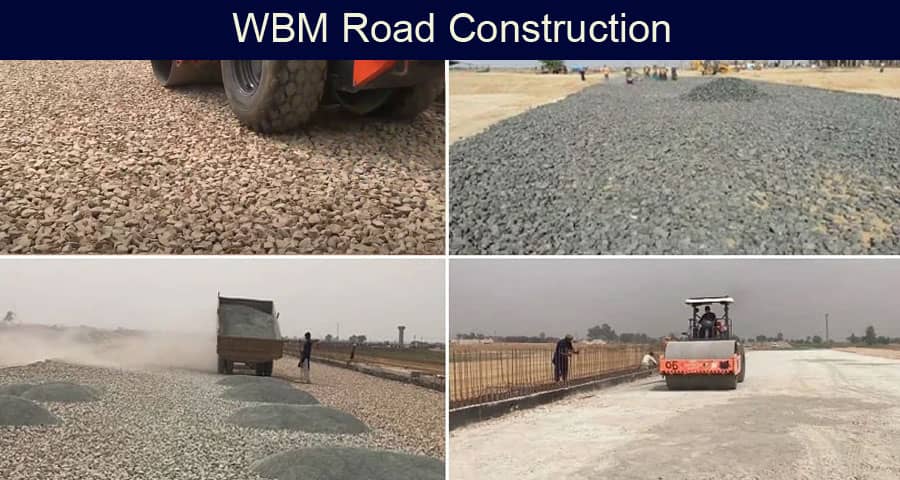
Although not a raw material, rolling equipment plays an essential role in achieving compaction of the materials used. Without proper compaction, even high-quality materials may fail to produce a durable road.
Types of Rollers Used
- Three-wheel power rollers (8 to 10 tonnes)
- Vibratory rollers for better compaction
- Smooth wheel rollers for finishing
Proper rolling ensures interlocking of aggregates, filling of voids, and formation of a dense surface crust.
7. Additional Materials for Special Cases
In certain situations, additional materials may be used to enhance the performance of WBM roads.
- Sand: Used in case of scarcity of screenings.
- Bituminous materials: Sometimes sprayed as a primer coat to improve binding.
- Cement or lime: Added in special cases where higher stability is required.
8. Material Requirements for Different WBM Layers
The material requirements vary depending on whether the WBM is laid as a base course or surface course.
For Base Course
- Coarse aggregates: 90 mm to 40 mm size
- Screenings: Gravel or stone dust
- Binding material: Soil with low plasticity
For Surface Course
- Coarse aggregates: 63 mm to 40 mm size
- Screenings: Stone dust or moorum
- Binding material: Non-plastic soil with PI < 6
The correct selection ensures that the base provides adequate support while the surface course delivers durability against traffic loads.
9. Quantity of Materials Required for WBM Road Construction
For 1 km length of WBM road (single lane, 3.75 m wide, 75 mm thick), the approximate material requirements are:
- Coarse aggregates: 90 - 100 cubic meters
- Screenings: 12 - 15 cubic meters
- Binding material: 6 - 9 cubic meters
- Water: 1,500 - 2,000 liters
(These values may vary depending on soil conditions, traffic load, and specifications.)
Conclusion
The construction of a WBM road relies heavily on the proper selection and application of materials. From coarse aggregates and screenings to binding materials and water, each component plays a vital role in delivering strength, stability, and long-lasting performance. Ensuring the quality of these materials is the key to building a road surface that can withstand traffic loads, resist weather conditions, and offer reliable service over time.
Please watch the following short video for Material Required for Construction of WBM Road
Also Read:
 Definition and different between Main bar and Distribution bar
Reinforced Concrete Design Of Tall Buildings
Deflection Angle: Definition, Causes, Measurement, and Significance
Construction Accidents: Causes, Prevention, and Consequences
Construction Adhesive at Home Depot: Finding the Perfect Solution for Your Projects