
Sulphate Resisting Cement (SRC): Properties, Uses, and Advantages
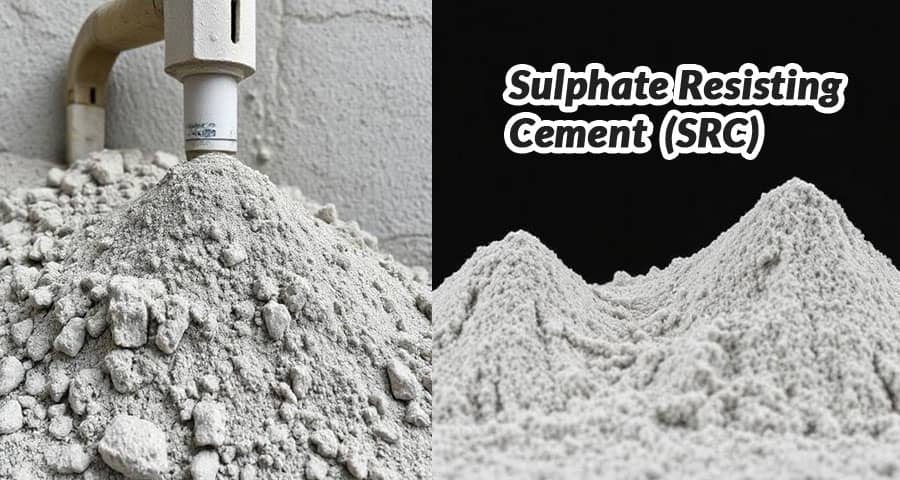
Sulphate Resisting Cement (SRC) is a specialized type of Portland cement formulated to resist the destructive effects of sulphate salts present in soil, groundwater, and seawater. It is widely used in construction projects where structures are exposed to severe sulphate attack, ensuring longer durability and minimal deterioration over time.
What is Sulphate Resisting Cement (SRC)?
Sulphate Resisting Cement is a modified form of Ordinary Portland Cement (OPC) with a reduced percentage of tricalcium aluminate (C3A), typically limited to less than 5%. By lowering the C3A content, SRC significantly reduces the risk of sulphate attack, which often leads to expansion, cracking, and structural weakening. This makes it highly suitable for foundations, marine works, and hydraulic structures.
Chemical Composition of Sulphate Resisting Cement
The chemical composition of SRC is carefully designed to enhance its resistance to sulphates. The typical composition includes:
- Lime (CaO): 60 - 67%
- Silica (SiO2): 17 - 25%
- Alumina (Al2O3): 3 - 8% (with C3A < 5%)
- Iron Oxide (Fe2O3): 0.5 - 6%
- Magnesia (MgO): 0.1 - 4%
- Sulphur Trioxide (SO3): 1 - 3%
- Alkalies (Na2O, K2O): 0.2 - 1%
The reduced alumina content makes SRC superior in areas with high sulphate concentration.
Properties of Sulphate Resisting Cement
Sulphate Resisting Cement possesses distinctive physical and mechanical properties:
- Color: Similar to OPC but slightly lighter in shade.
- Setting Time: Initial setting time is around 30 minutes, and final setting time is 600 minutes (approx.).
- Fineness: Greater fineness for better hydration and strength development.
- Compressive Strength: Achieves about 10 MPa in 3 days, 16 MPa in 7 days, and 33 MPa in 28 days.
- Durability: Excellent resistance to sulphate-rich soils, groundwater, and seawater.
- Workability: Comparable to OPC, with slightly reduced heat of hydration.
Manufacturing of Sulphate Resisting Cement
The manufacturing process of SRC is similar to OPC, with a few modifications to control the C3A content:
- Raw Material Selection: High-quality limestone, clay, and iron ore are chosen.
- Proportioning: The mix is proportioned to maintain C3A below 5%.
- Burning: Raw materials are burned in rotary kilns at temperatures around 1400 - 1500°C.
- Clinker Formation: The resulting clinker contains low alumina compounds.
- Grinding: Clinker is finely ground with gypsum to regulate setting time.
- Quality Control: Strict checks ensure sulphate resistance and compressive strength.
Advantages of Sulphate Resisting Cement
Using SRC in construction projects provides multiple benefits:
- High Resistance to Sulphate Attack - Prevents deterioration caused by sulphate salts.
- Durability - Enhances the lifespan of structures in aggressive environments.
- Reduced Cracking and Expansion - Limits expansion due to sulphate reaction.
- Suitable for Marine Construction - Ideal for harbors, piers, and sea walls.
- Low Heat of Hydration - Reduces thermal stresses in mass concrete structures.
Disadvantages of Sulphate Resisting Cement
Despite its advantages, SRC has some limitations:
- Higher Cost compared to OPC due to controlled manufacturing.
- Limited Availability in certain regions.
- Lower Early Strength compared to OPC.
- Not Suitable for All Conditions - Ineffective against acidic attacks.
Applications of Sulphate Resisting Cement
Sulphate Resisting Cement is extensively used in structures exposed to aggressive environments:
- Marine Structures: Docks, harbors, jetties, seawalls, and offshore platforms.
- Foundations in Sulphate-Rich Soils: Pile foundations, basements, and retaining walls.
- Sewage and Water Treatment Plants: Resistant to sulphate-rich effluents.
- Hydraulic Structures: Dams, canals, and culverts.
- Industrial Flooring: Factories where sulphate chemicals are handled.
Difference Between SRC and OPC
| Parameter | Sulphate Resisting Cement (SRC) | Ordinary Portland Cement (OPC) |
|---|---|---|
| C3A Content | Less than 5% | 7 - 12% |
| Resistance to Sulphates | High | Moderate |
| Cost | Higher | Relatively Lower |
| Strength Development | Slower in early stages | Faster early strength |
| Applications | Marine works, foundations, sewage plants | General construction works |
Testing of Sulphate Resisting Cement
To ensure quality, SRC undergoes several standard tests:
- Fineness Test - To check the surface area of particles.
- Setting Time Test - Ensures proper working time.
- Compressive Strength Test - Conducted at 3, 7, and 28 days.
- Soundness Test - Prevents expansion due to free lime.
- Chemical Analysis - Verifies that C3A content is within limits.
Why Use Sulphate Resisting Cement?
In regions where sulphate-rich soils and water are prevalent, using OPC can lead to severe deterioration within a few years. SRC, on the other hand, provides long-term strength, reduced maintenance costs, and enhanced structural safety. It ensures that infrastructure such as bridges, tunnels, and marine facilities withstands aggressive chemical environments for decades.
Conclusion
Sulphate Resisting Cement (SRC) is an essential construction material for environments exposed to sulphate attack. With its low C3A content, superior resistance, and long-term durability, it has become the cement of choice for marine works, foundations, hydraulic structures, and sewage treatment facilities. While it may cost slightly more than OPC, the extended lifespan and reduced maintenance costs make it a highly economical option in the long run.
Please view the following short video for Sulphate Resisting Cement
Also Read:
 Bid Day Analysis: Unveiling the Secrets to Successful Bidding